
Insights & resources
Multi-Location SEO for Australian Businesses: How to Rank in Multiple Cities
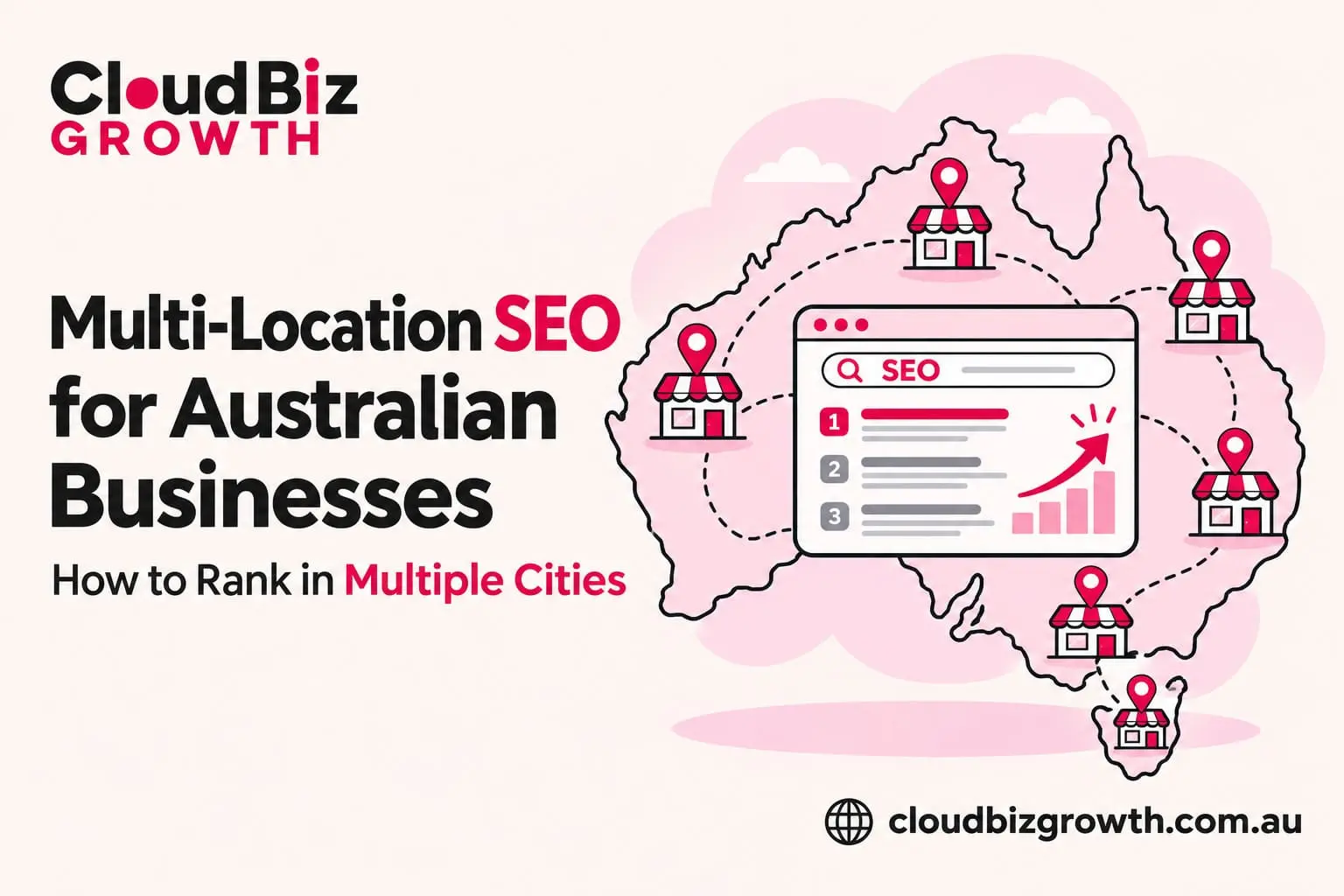
Running a business across several Australian cities will create exciting growth opportunities. But attracting customers in Melbourne, Sydney, Brisbane, Perth and Adelaide will require more than launching a website and hoping Google understands where you operate.
A customer searching for “accountants near me” in Brisbane can expect different results from someone making the same search in Melbourne. So businesses will need a multi-location SEO strategy that connects their services with customers in each target area.
If you manage a healthcare practice, retail chain, franchise, professional services company or home service business, multi-location local SEO will help strengthen your online presence across different geographical markets.
This will allow each branch to compete locally while maintaining one recognisable business identity.
Here, Cloud Biz Growth will explain how Australian businesses will improve their Google Maps rankings, attract qualified enquiries from multiple cities, and optimise location pages.
What Is Multi-Location SEO?
The process of multi-location SEO is optimising a business’s online presence to improve its visibility across several physical locations or service areas.
Instead of targeting one geographical market, businesses develop search strategies, location-specific website pages, and business information.
For example, an Australian dental group operating in Newcastle, Sydney, and Wollongong may want to rank for:
- Dentist in Sydney
- Emergency dental clinic Wollongong
- Family dentist Newcastle
- Dental clinic near me
Though these searches relate to similar services, Google will consider the searcher’s location and local business relevance.
Each genuine business location will need clear information that helps customers find the right branch. Get details on Dental Clinic SEO Services in Australia.
Why Multi-Location SEO Matters for Australian Businesses
Australia’s major cities will contain highly competitive local markets. Also, suburbs often have their own customer expectations, search patterns, and competing businesses.
A company that performs well in Melbourne’s CBD can struggle to attract customers in Geelong or Ballarat without a targeted local strategy.
Effective local SEO for multiple locations can offer several advantages.
Greater local search visibility: Each location will target relevant suburbs, cities and service-related searches.
More qualified website traffic: Location-specific pages connect customers with nearby services. Instead of sending everyone to one generic homepage.
Improved Google Maps presence: Eligible branches will maintain accurate Google Business Profiles and appear in relevant local searches.
Stronger customer confidence: Local contact details, photographs, reviews,and opening hours will help customers make informed decisions.
Better business expansion: A repeatable SEO framework will make it easier to introduce additional branches as the company grows.
Google identifies distance, relevance, and prominence as the main factors will influence local rankings. So businesses must focus on improving relevance and reputation while recognising that physical distance will affect results. Get details on SEO Services in Sydney.
1. Create Dedicated SEO Landing Pages for Every Location
A common mistake will involve listing every office address on one contact page.
Though that approach will provide basic information. It will rarely offer enough detail about each branch.
But create dedicated location landing pages for genuine business locations.
For example:
| Business location | Suggested URL structure |
| Sydney | /locations/sydney/ |
| Melbourne | /locations/melbourne/ |
| Brisbane | /locations/brisbane/ |
| Perth | /locations/perth/ |
| Adelaide | /locations/adelaide/ |
Each location page must include its own relevant content.
Add the branch’s address where appropriate, opening hours, local phone number, services, directions and customer testimonials.
Include information about nearby suburbs, accessibility, parking facilities, and local service availability.
Avoid copying identical paragraphs across every page. Also replace only the city name. Explain what makes each location useful to its customers.
Example SEO title:
Digital Marketing Agency in Melbourne | Cloud Biz Growth
Example meta description:
Are you looking for a digital marketing agency in Melbourne? Explore Google Ads, local SEO, and online marketing solutions with Cloud Biz Growth.
Use such location-specific claims only when they reflect the business’s real operations.
2. Optimise Google Business Profiles for Eligible Locations
A well-maintained Google Business Profile will help customers discover local businesses through Google Search and Google Maps.
For businesses operating multiple genuine branches, managing these profiles consistently can become important.
Each eligible location must have accurate details, including its official address, business name, or service area, phone number, operating hours, categories and website link.
Upload genuine photographs. Also maintain accurate holiday hours.
Don’t create a separate listing just because your business serves another suburb.
Google will require a legitimate business location. Service-area businesses will qualify for additional profiles when they operate distinct locations with separate staff and service areas. Virtual offices without qualifying operations are not eligible.
3. Target Location-Specific Keywords
Using identical keywords across every branch will limit the effectiveness of your SEO campaign.
But conduct local keyword research for individual cities and suburbs.
For example, customers can search for “SEO agency Sydney,” “local SEO Melbourne,” or “Google Ads management Brisbane.”
Different search phrases can reveal different customer intentions.
| Keyword type | Example | Search intent |
| City-based | SEO agency Sydney | Find a local provider |
| Suburb-based | Dentist Parramatta | Find a nearby clinic |
| Service + location | Emergency plumber Brisbane | Request a specific service |
| Near-me | Phone repair near me | Find a convenient provider |
| Commercial | Local SEO packages Melbourne | Compare providers and prices |
Use Google Keyword Planner, Google Search Console, and reputable keyword research tools to explore demand.
Then you can assign relevant primary and secondary keywords to each page.
But avoid repeatedly inserting city names into paragraphs. Natural writing will support a better experience than aggressive keyword stuffing.
4. Maintain Consistent Business Information Across the Internet
Your business name, phone number and address form what marketers commonly call NAP information.
Customers will find these details on Google Maps, social platforms, business directories, and your own website.
So inconsistent information will create confusion.
Think of a Sydney branch displaying one phone number on its website and another in a business directory. Customers can call the wrong office or abandon their enquiry.
Regularly audit important listings. This includes relevant Australian business directories, maps and industry websites.
You can update them whenever a branch relocates, closes permanently, or changes its operating hours.
Consistency will support a reliable customer experience. It can reduce conflicting business information online.
5. Build Local Authority Through Reviews and Relevant Links
A business that operates across Australia must develop a genuine reputation in each market.
Encourage customers to review the location they actually visited.
Then respond professionally to feedback. This can include complaints.
For instance, a Melbourne customer reviewing a Melbourne branch will provide useful information to future customers considering that branch.
Beyond reviews, you can look for legitimate local partnerships.
Relevant opportunities will include local chambers of commerce, community organisations, industry associations and sponsorships.
These relationships will generate referral traffic, local backlinks, and stronger brand awareness.
But avoid buying large quantities of low-quality directory links. Quality and relevance will matter more than inflated link counts.
6. Use Local Business Schema Markup
LocalBusiness schema markup will help search engines interpret structured information about individual branches.
For instance, schema can describe a business’s name, telephone number, address, operating hours and geographical details.
Add location-specific structured data to individual branch pages where suitable.
Then include relevant Organization and BreadcrumbList markup.
Google will document LocalBusiness structured data as a way to communicate details about physical businesses. But adding schema alone will not guarantee higher rankings or enhanced search appearances.
7. Improve Internal Linking and Website Navigation
Customers must find their nearest branch without searching through multiple menus.
Therefore, create a central locations directory that links to individual branch pages.
For example, a national home services company could have a main “Our Locations” page with separate links to Sydney, Melbourne and Brisbane.
Additionally, link relevant service pages to their corresponding location pages.
Use descriptive anchor text like plumbing services in Brisbane, rather than generic wording like “click here”.
This structure will help visitors navigate the website while allowing search engines to discover related pages.
8. Optimise for Mobile and Voice Search
Many local searches can happen on smartphones. Especially when customers will need quick assistance.
So mobile usability must form part of every Australian multi-location SEO campaign.
Make telephone numbers clickable, ensure pages load efficiently, and simplify enquiry forms.
Use conversational questions that will reflect natural search behaviour.
For instance:
“Where can I find an emergency electrician in Parramatta?”
“Which accounting firms operate near Melbourne CBD?”
Clear answers, helpful FAQs and accurate branch details will support traditional search, voice-driven discovery and AI-generated search experiences.
No particular wording will guarantee inclusion in an AI-generated answer.
9. Monitor SEO Performance for Each Location
Tracking national website traffic alone can hide underperforming branches.
Instead, measure results for individual location pages and business profiles.
| SEO metric | What it measures | Suggested review |
| Organic clicks | Search traffic to each location page | Monthly |
| Local keyword visibility | Rankings across target areas | Monthly |
| Google Business Profile interactions | Calls, clicks and direction requests | Monthly |
| Enquiry conversions | Leads generated by location | Monthly |
| Customer reviews | Feedback volume and quality | Weekly |
| Location-page engagement | Visitor interactions and page performance | Monthly |
These review intervals are practical recommendations. Not Google requirements.
Use Google Analytics 4, Google Search Console, and relevant Google Business Profile performance reports.
You can compare results across branches to identify opportunities.
For instance, when Brisbane attracts visitors but receives fewer enquiries than Adelaide, investigate its landing page, contact information and conversion process.
10. Avoid Common Multi-Location SEO Mistakes
Even established businesses will weaken their local visibility through preventable errors.
Some of the common mistakes include creating thin duplicate location pages, ignoring reviews, targeting cities and publishing inaccurate branch information where the company has no meaningful operations.
Another mistake will involve producing hundreds of location pages that offer almost identical information.
Google’s spam policies can warn against doorway pages and scaled content that attempts to manipulate search rankings without offering genuine visitor value.
Instead, prioritise useful pages with accurate service coverage and locally relevant details.
Related Services:
» WordPress SEO Services in Australia
» Wix SEO Services in Australia
» Magento SEO Services in Australia
How Long Does Multi-Location SEO Take?
Multi-location SEO will be an ongoing investment, rather than a one-time website update.
Some technical corrections and business information improvements may become visible relatively quickly. But competitive local keyword rankings will often require several months of consistent work.
Results will depend on the competition, local authority, website history, existing content and geographical market.
Businesses must measure progress through meaningful enquiries and organic conversions. Instead of expecting instant first-page rankings.
Related Articles:
» How Much Does Local SEO Cost in Australia?
» Local SEO Checklist for Australian Small Businesses
» Multi-Location SEO for Australian Franchise Businesses
» Google Maps SEO: How Local Rankings Work?
» How to Optimise Your Google Business Profile?
How Cloud Biz Growth Helps Australian Businesses Grow Across Multiple Locations
Managing digital visibility across several cities will quickly become complicated.
Cloud Biz Growth will help Australian businesses develop practical multi-location SEO strategies that support consistent branding. Also, location-specific marketing.
Our approach will focus on local keyword research, Google Business Profile guidance, location-page optimisation, technical SEO, content development and performance measurement.
Rather than treating every city as an identical market, we will consider the unique search opportunities each location presents.
If your business operates several established branches or plans to enter new Australian markets, a structured SEO strategy will strengthen your digital presence.
Are you looking to improve your local rankings across Australia? Contact Cloud Biz Growth to discuss a multi-location SEO strategy for your business.
FAQs: Multi-Location SEO for Australian Businesses
1. What is multi-location SEO, and how does it work in Australia?
Multi-location SEO will help businesses improve their search visibility across several suburbs, cities, or physical branches. It will combine location-specific website pages, keyword research, accurate business profiles, and local reputation management. Cloud Biz Growth will help Australian businesses develop strategies that reflect their actual service locations.
2. How can my business rank on Google in multiple Australian cities?
Start by creating useful location-specific pages. Then improve the accuracy of your business information. Also target relevant local keywords, strengthen your website’s authority and develop genuine reviews. But local rankings will depend on competition, search relevance and the customer’s location.
3. Does every business location need a separate Google Business Profile?
Each eligible and independently operating location can maintain its own Google Business Profile. But businesses must follow Google’s location and service-area eligibility rules. Simply serving customers in another suburb will not automatically justify another profile.
4. Should I create separate landing pages for Sydney, Melbourne and Brisbane?
Yes. Separate pages will benefit visitors when each page provides meaningful information about the business’s operations in that location. This includes accurate service availability, relevant customer information, contact details, and unique content. Avoid generating near-identical pages only to target additional city keywords.
5. What is the difference between local SEO and multi-location SEO?
Local SEO will focus on improving visibility within one geographical market. Multi-location SEO can apply similar principles across several branches or service areas. While maintaining a consistent overall brand. So multi-location campaigns will require additional planning, content management and performance tracking.
6. How much does multi-location SEO cost in Australia?
Pricing will depend on the market competition, number of locations, website condition and services required. For instance, managing three branches will involve less work than coordinating a national network of 50 branches. Cloud Biz Growth will assess the scope and recommend an SEO plan based on business requirements.
7. How long does it take to rank multiple business locations on Google?
Improvements will appear at different times depending on each market’s competitiveness. Also, existing search visibility. Some businesses will notice early progress within a few months. Competitive locations can require longer campaigns. Consistent optimisation and regular measurement will remain important.
8. Can a service-area business use multi-location SEO without physical offices?
Yes. Businesses can create useful website content for areas they can genuinely serve. But they must not misrepresent virtual offices or create ineligible Google Business Profiles. Cloud Biz Growth will help distinguish between legitimate service-area landing pages and physical branch optimisation.
9. How do Google reviews affect multi-location SEO?
Reviews will help prospective customers evaluate the reliability and service quality of individual branches. Google can identify review quantity and positive ratings among the signals that can contribute to local prominence. Businesses must encourage genuine feedback without offering prohibited incentives or manipulating reviews.
10. What are the best keywords for multi-location SEO in Australia?
Useful keywords combine services with relevant cities, suburbs and customer needs. Examples will include “accountant Sydney CBD”, “emergency electrician Perth” and “commercial cleaning Brisbane”. The strongest keyword strategy will consider actual search demand, customer intent and each location’s service offering.
11. Can multi-location SEO improve visibility in Google AI Overviews and ChatGPT?
Strong local content, credible online references and clear business information will make a company easier for search and AI systems to understand. But AI services will use different information sources and selection processes. So visibility cannot be guaranteed. Cloud Biz Growth will focus on SEO, AEO and GEO practices that improve content clarity, relevance and discoverability.
12. Why should Australian businesses choose Cloud Biz Growth for multi-location SEO?
Cloud Biz Growth can approach multi-location SEO through individual market research, website optimisation and practical performance analysis. Our focus will include strengthening location-specific content, supporting genuine local visibility and improving technical foundations. This will help businesses develop an organised strategy for attracting customers across multiple Australian locations.













One Response